How we made advanced topics clearer
November 1, 2026
One of us asked Kumuao for a game about PID control for a 15-year-old on a VEX robotics team. PID is how a robot gets to a spot and stops there: it keeps checking how far it still has to go and decides how hard to push. Every VEX team ends up tuning one.
The game was correct, and the tuning challenges were good. The explanation before them wasn't. Each scene packed two or three ideas into a long paragraph, used words like "gain" and "bang-bang" before showing what they meant, and finished on a formula with calculus symbols. In the first scene the text said the robot "jitters back and forth" while the picture showed it gliding smoothly to the target.
Extra rules for explaining advanced ideas
We wrote down what a clear explanation of an advanced idea does, and added it to the instructions our AI follows:
- Big picture first. The first scene says what problem the idea solves, in one plain sentence, before naming any part.
- One idea per scene, in about 25 words.
- Show it, then name it. No term, symbol or formula until a scene has shown what it means. No formulas at all under 13.
- The picture does what the words say. If the text says the robot overshoots, you see it overshoot.
- Graphs are labelled ("position", "time", "target") in the scene that brings them in, one at a time.
- One situation throughout, and a title that says what the game teaches.
The test
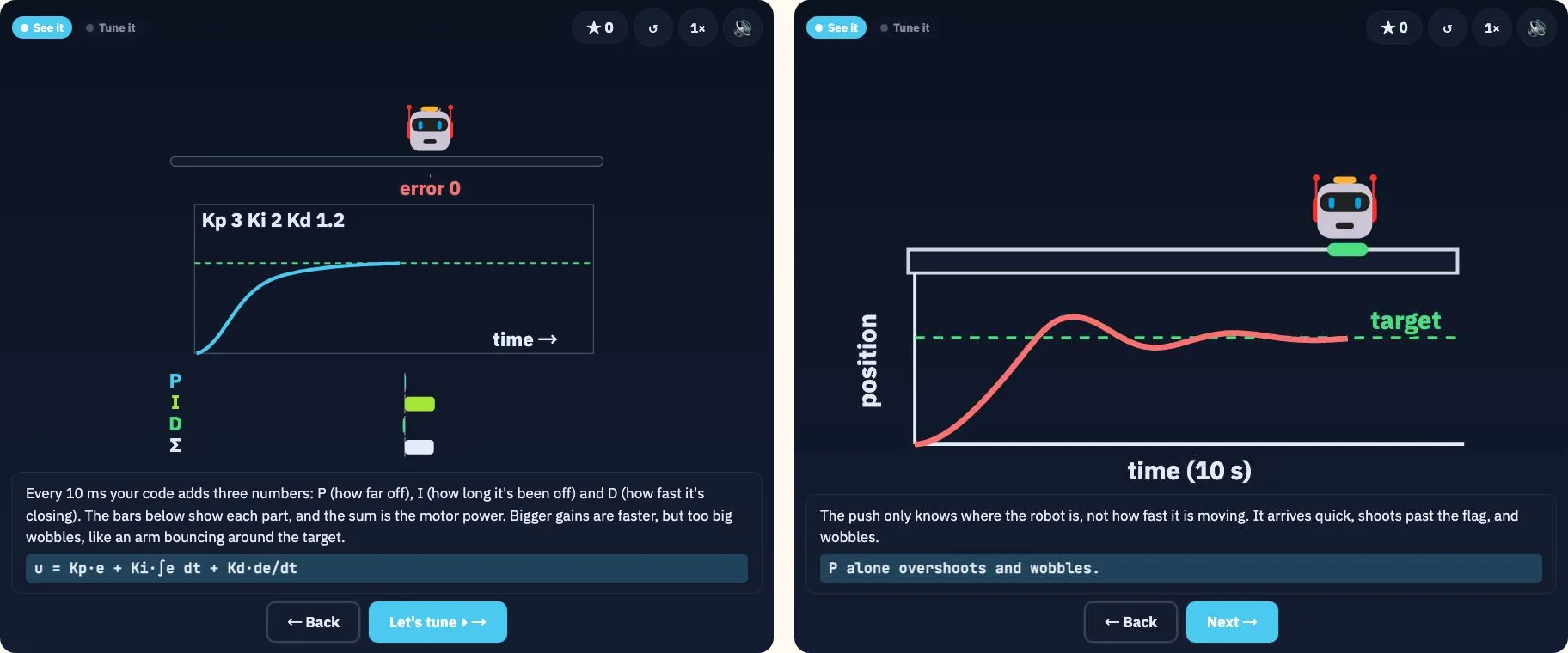
We built the same topics with the old and the new rules, put the scenes side by side, and compared them scene by scene. Each game was built once per version, so this is a small test.
- PID, for a 15-year-old: much better. Big picture first, then P, D and I one at a time, each shown on the robot and on a labelled graph. The title went from "Hold the Line" to "PID: Park on the Flag".
- Fractions for an 8-year-old, and seasons for a 10-year-old: already clear. Our usual approach was built and tuned for young learners, and it goes straight to the point. The extra steps didn't make these games any clearer, so they keep the approach that already works. We made this call on quality alone.
We also tried rebuilding the PID game from the parent's feedback. That version came out different, but not better than the one built straight from the new rules.
Which games get the extra rules: it depends on the idea, not the age
Before building a game, Kumuao already checks what you asked for. Now that check also decides whether the idea itself is advanced: something usually first taught in high school or later, like PID, sorting algorithms, derivatives or how neural networks learn. Those games get the extra rules.
- "Explain PID to my 10-year-old" gets them. The idea is advanced, even if the player is young.
- "Fractions, for an adult who never got them" keeps our usual approach, which already explains fractions clearly.
On 14 test requests the check sorted every one the way we expected. Everyday topics like fractions, seasons or the water cycle, which are most of what families ask for, keep the approach we built for them.
Clearer costs more, and that's our choice
Following these rules, the AI thinks longer. A game on an advanced topic now costs us about 40% more to build, and you may wait a little longer for it. We decided it's worth it.
This isn't a one-off. As we keep improving how Kumuao teaches, we ask more of the AI, and what each game costs us keeps going up. Each time, we choose the better lesson over the cheaper one. We want Kumuao to be a tool parents and teachers can really rely on, so quality comes first. The extra cost is ours.
Also new: asking for a new version
If a game doesn't teach the way you hoped, tap "Report a problem", say what you'd like, and ask for a rebuild. Until now a rebuild only touched up the existing game, so it barely changed. Now feedback on the content or the difficulty gets a new version designed around what you said. "It doesn't work" still just fixes what's broken.
What we don't know yet
We judged the games ourselves, a few topics at a time. We'll keep checking new games, and if one explains badly, whatever the topic, the report button is the fastest way to tell us.